Interests
Our research focuses on understanding both the basic principles of neural encoding and how basic coding can be altered. Specifically, the lab focuses on the coding of odor and taste stimuli.
Olfaction
Within the olfactory bulb, odors are represented as topographical maps of olfactory sensory neuron input. This input can be modulated by both intrinsic inhibitory circuits within the bulb as well as by centrifugal input from several regions of the brain, including neuromodulatory centers, that project into the olfactory bulb.
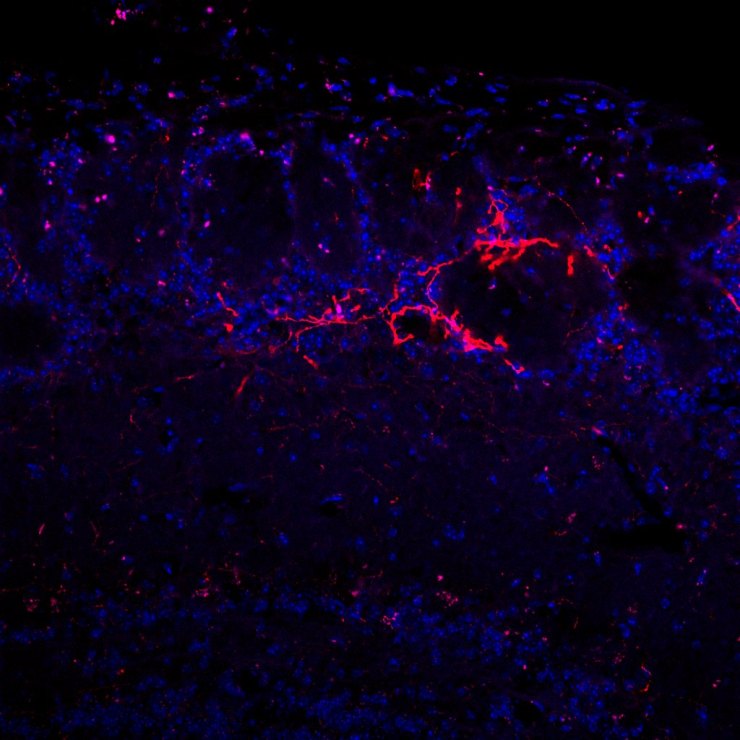
Confocal image of centrifugal fibers in OB glomeruli 
2-photon image of centrifugal fibers in OB
One project recently established that acute odor experience can dampen both olfactory bulb responses and behavioral responses to odor information but that stimulation of olfactory bulb acetylcholine is capable of reinstating both neural responses and behavioral perception. We are currently further assessing how acetylcholine modulates both olfactory behavior and olfactory bulb neural responses, as well as characterizing cholinergic neurotransmission in the olfactory bulb.
We are also interested in understanding the neural mechanisms underlying fear learning and generalization. We have recently demonstrated that olfactory fear conditioning induces freezing to several odors, even those never paired with a fear-inducing stimulus, as well as global changes in olfactory coding. We are excited to continue investigating olfactory bulb alterations as a result of learning and how those changes ultimately relate to animal perception and behavior.
Techniques – animal behavior, in vivo pharmacology, optogenetics, wide-field calcium imaging, 2-photon calcium imaging, gene expression analysis, circuit tracing
Gustation
Another goal of the lab is to elucidate coding mechanisms of taste stimuli, specifically in the gustatory cortex, a region that plays an essential role in taste learning and stimulus salience. However, given that gustatory cortex is located deep in the brain, making it difficult to access with traditional methods, it is not currently clear how taste quality is encoded in this area, nor how coding might change with experience or as a result of learning. Therefore, we are systematically mapping taste responses along the anterior-posterior axis and with respect to dorsal-ventral depth as well as investigating taste responses in neurons following taste aversion learning and extinction.
Techniques – animal behavior, 2-photon calcium imaging, circuit tracing, freely-moving miniscope imaging
2-Photon imaging of gustatory cortex:
Miniscope recordings:
 the fletcher lab